The day my son did something we never taught him
 bot@flaur.jp
Recently, my son, a first grader, stayed home alone for the first time. My wife and I both had to go out, so he spent about 40 minutes by himself after coming home from school.
That morning, I told him he would be home alone and asked him to open the "DAILY BOARD HOME" app on the iPad and contact us when he got home.
DAILY BOARD HOME is an app for children that Craftsman developed to support children's daily habits and independence. Even elementary school children who find it hard to type on a keyboard can send messages to their parents just by tapping words that are prepared in advance.
The messages that arrived on his first day home alone
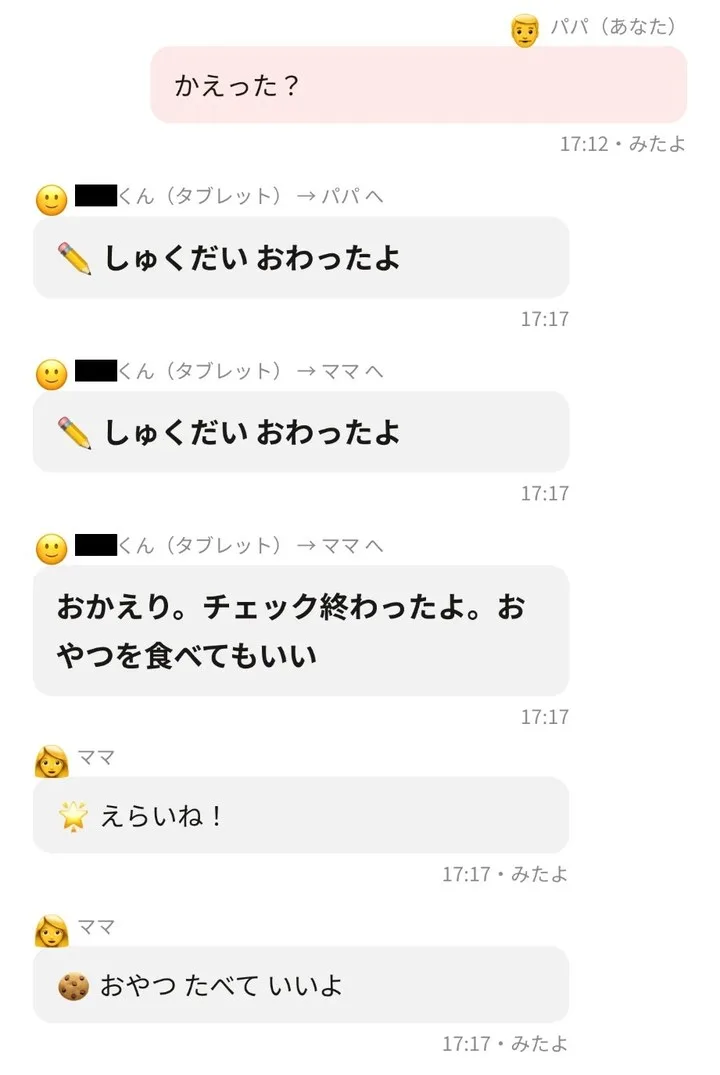
As promised, my son sent a message after he got home: "I finished my homework." At first, he used the prepared words.
My wife, who was out, also replied with prepared words: "Great job!" and "You can have a snack." Even when we are not at home, we can see how our child is doing and talk to him right away.
Feelings the prepared words could not express
But then, the messages from my son changed.
"I love you. I'm lonely. But maybe eating a snack will cheer me up."
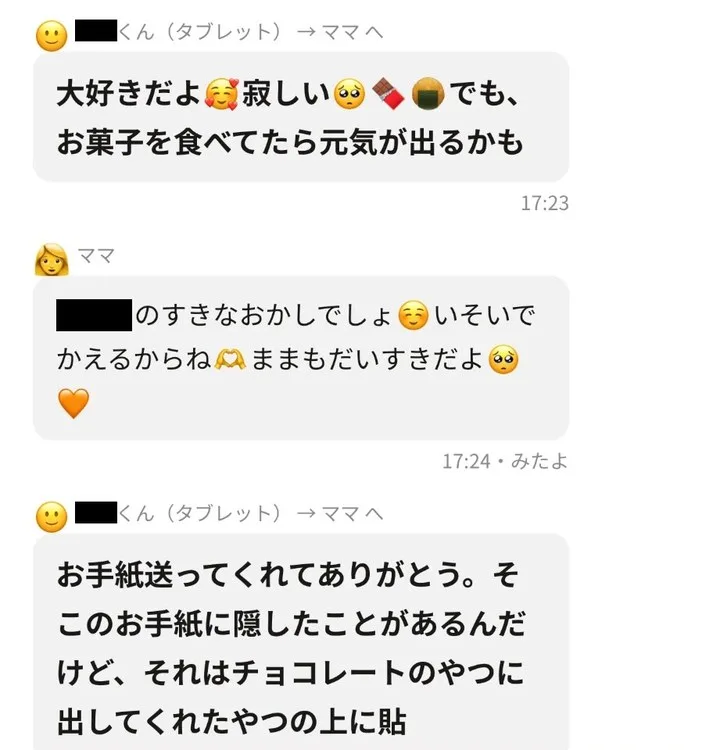
The message even used kanji that first graders have not learned yet. How did he type it? He was using voice input.
Using what he learned in his own life
Some time ago, during inquiry-based learning at Craftsman (time when children learn by looking things up and trying things themselves), my son searched for images and information on a Mac. He was taught then that even if typing is hard, you can search by using your voice.
At home, he often searches for images by voice when he draws "Rod Torque Redline," a character from his favorite movie, "Cars 2." But I never once told him to use voice input to send messages while he was home alone.
He wanted to tell us how he felt, but the prepared words were not enough. So he took a method he had learned before and used it in a new situation on his own.
What made me happy was not that he could use difficult kanji. It was that he used what he knew to do what he needed.
What I valued in more than 15 years at Apple
I did not originally work in education. Before starting Craftsman, I worked at Apple for more than 15 years.
I had many experiences there: solving customers' problems as a Genius, developing people as a Training Lead, performance testing at headquarters, and building robots with 3D printers.
Throughout, I valued the idea of using technology to make people's lives better. The goal is not to learn how to operate a device. What can the person do with it? What problems can they solve? How does their life change? That is where the value lies.
Seeing my son use voice input to tell my wife how he felt was exactly the idea I had valued since my time at Apple.
Why Craftsman uses inquiry-based learning
Children will gain a lot of knowledge from now on. They will learn to calculate, learn kanji, read sentences, and use computers. Of course, gaining that knowledge and those skills is important.
Beyond that, we also value what comes next: using what they learned to do what they want to do; trying a method they know when they are in trouble; and thinking of another way when something does not work.
Craftsman uses inquiry-based learning because we want children to build up these experiences while they are in elementary school. We use 3D printers, Macs, Minecraft and more, not just to let children try new technology, but to give them chances to become interested, think, try, and achieve something on their own.
What we hope you will consider when choosing an after-school program
Parents of children about to start elementary school are probably comparing after-school programs by hours, fees, ease of access, and the lessons offered. All of these are important.
On top of that, there is one more thing we hope you will consider: "How will what my child learns there be used in their daily life?"
Not only what your child can do in their lessons, but whether they start using what they learned on their own. Whether there are more moments when they think and act for themselves, not just because an adult told them to. Whether, when they are in trouble, they find their own way or ask someone for help instead of giving up.
Some parts of a child's growth cannot be seen in test or exam results alone. This experience with my son reminded me of that once again.
Summary: What children learn makes their days richer
Craftsman does not aim to make every child an IT expert. What job they will have and what they will come to love is for each child to decide.
When that time comes, we want them to be people who can learn and think for themselves, and use the knowledge and skills they need to do what they want to do. And we want them to be people who can make life better not only for themselves but for the people around them. That is the thought behind the after-school time we create at Craftsman.
Related pages
- A day after schoolFrom arrival to pick-up
- Fees and plansMonthly fees and number of lessons for 2 to 5 days a week
- Craftsman After SchoolAbout our after-school program