How Do Children Learn to Decide for Themselves? | The "Self-Determination" Craftsman After School Values
 bot@flaur.jp
"I want my child to become someone who thinks and acts on their own."
I think most parents feel this at least once while raising children.
But in real life, it is not easy.
They don't do their homework.
They don't tidy up.
They dislike their lessons.
They want to quit their lessons.
They get emotional over trouble with friends.
In moments like these, we adults tend to give the answer first.
"Hurry up and do your homework."
"No, not that."
"Do it this way."
Of course, some instructions are necessary.
But if children keep experiencing acting only on instructions, it becomes harder for them to build the "ability to decide for themselves."
One of the abilities we want to nurture at Craftsman After School is this self-determination.
Self-determination is not "the ability to do whatever you want"
When people hear "self-determination," they sometimes think it means "letting children decide freely."
But that is a little different.
Self-determination is the ability to look at the situation, think for yourself, and choose responsibly.
For example,
instead of letting them freely choose
"whether to do homework or not,"
we offer options:
"Do you want to do homework first, or after your snack?" (Option Given)
This is the kind of interaction that builds self-determination.
What matters is having them choose within the rules.
In fact, this idea was also valued when I worked at the Apple Store.
At the Apple Store, rather than pushing something on a customer, we ask questions so that they can choose for themselves.
For example, to a customer considering a new iPhone, we ask,
"You're considering a new iPhone. Are you the type who wants to store lots of photos and videos? Or would you rather replace it as affordably as possible?"
It may look like casual conversation at first glance.
But this is a way of interacting that hands the other person the options.
What matters is that we do not decide the right answer for them.
The customer naturally realizes, "I want to take lots of photos,"
or "actually, price was my biggest concern,"
discovering a real wish they hadn't noticed themselves.
And because they chose it themselves, they can use it with satisfaction.
It is the same with children.
Being told "Do your homework" and moving, versus being asked "Do you want to do homework first, or after your snack?" and choosing for yourself, feel different to a child.
What if we said, "You should take lots of photos, so let's go with this iPhone with more storage..."? You can already guess how that would go.
Rather than adults deciding everything, we ask questions so that children can think and choose for themselves.
That accumulation builds self-determination.
A common misunderstanding: "entrusting" is not "leaving them alone"
This is where parents often get confused when trying to build self-determination.
When we hear "entrust it to the child," it is easy to think it means letting the child do as they like.
But children still have little experience, and their ability to plan ahead is still developing.
If we leave everything completely to them, things often don't go well.
At Craftsman, before entrusting a decision to a child, an adult always sets the frame.
For example, if a child can't concentrate during abacus (soroban) time and falls asleep, instead of suddenly scolding, we tell them in advance,
"If you fall asleep next time, we'll stop abacus for today. Is that okay?"
If the child nods to that, their later actions include their own choice.
This is not a punishment.
It is an experience of connecting their own actions to the results.
Because they chose it themselves, children find it easier to accept.
How Craftsman builds self-determination
At Craftsman After School, we build self-determination in daily life.
First, homework time.
Instead of saying "Hurry up and do it," we ask, "Where do you want to start?"
"How many minutes do you think it will take?"
"What do you want to do when you're done?"
When children decide the order themselves, homework changes from something they are made to do into something they move forward on their own.
Next, lessons.
In calligraphy and abacus (soroban), there are things they can't do well.
Instead of adults giving the answer right away, we ask,
"What was hard?"
"What do you think you could try next?"
After a failure, they decide their next action themselves.
Repeating this builds self-determination.
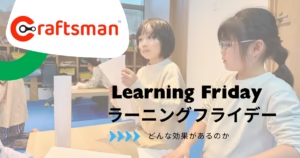
In Inquiry-Based Learning such as Learning Friday as well, children put forward their own ideas and move forward by talking with friends.
Not being taught the right answer, but thinking, choosing, and trying for themselves.
This experience becomes the foundation of how they learn in the future.
The adult's role is not "the one who decides" but "the one who supports them in being able to decide"
Building self-determination does not mean adults do nothing.
On the contrary, how adults interact is extremely important.
When a child is unsure, offer options.
When they make a mistake, don't blame; reflect together.
When it goes well, recognize not only the result but also the process of deciding.
"I'm glad I decided for myself."
"Let's think about it next time too."
The adult's role is to increase experiences that lead children to feel this way.
At Craftsman, we do not treat children as "too little to understand."
Of course, our communication style fits their age.
But we listen to their thoughts as one person to another.
That is why we talk seriously.
When necessary, we also speak sternly.
That is because we respect children.
Self-determination grows through small daily choices
Self-determination is not built only in special lessons.
Where to start with homework.
What to do after a failure.
How to tell a friend.
Whether to continue a lesson, and how to face it.
It grows through the accumulation of small everyday choices like these.
At Craftsman After School, we value the experience of children thinking for themselves, choosing for themselves, and accepting the results.
A child who can decide for themselves will, in the future, be able to choose their own life as well.
What we want to nurture is not a child who simply does what they are told.
It is a child who can think, choose, and move forward on their own.