The skill of going to the club on their own, growing at an after-school club in Kitayamata, Yokohama: growth we saw on a day without the Pickup Option
 bot@flaur.jp
"Will they get there okay on their own?"
On the days a child walks to the after-school club alone, it is probably an unsettling time for parents.
Have they left school?
Where are they walking now?
Did they take a wrong turn?
Are they goofing around too much with friends?
Will they get to the club safely?
Checking your child's location by GPS as they move, many parents probably felt both worry and a wish to watch over them a little.
Today was a day when the Pickup Option was not in use and many children came to Craftsman After School on their own.
For adults, "will they arrive safely?" is the biggest concern.
But looking at the children's faces, we felt there was great growth packed in there, beyond just a safety check.
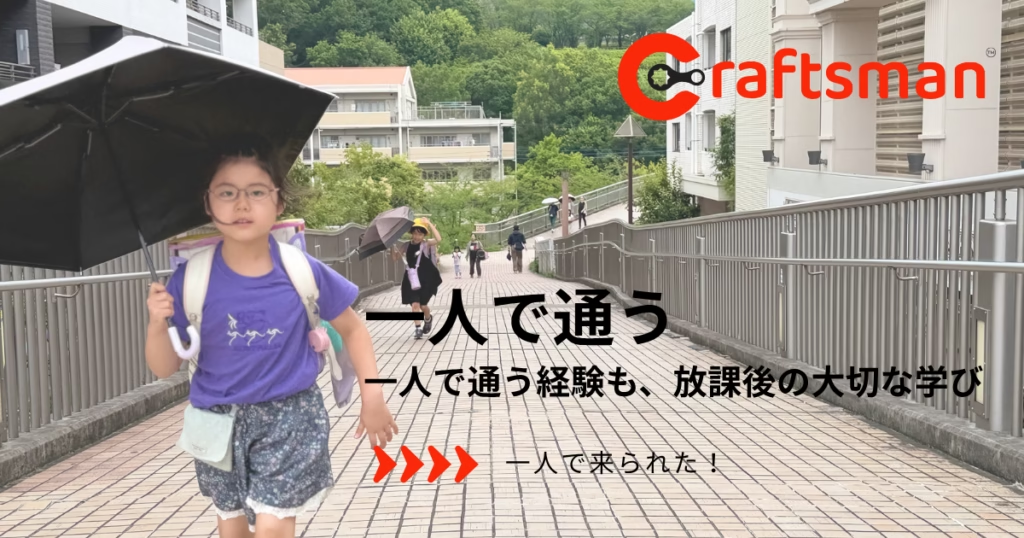
The look on their faces when we say "Welcome back! Were you okay?"
When the children arrive at Craftsman, we say,
"Welcome back! Were you okay?"
and many of them answer right away:
"I was fine!"
Their expressions are somehow proud.
They are not just giving an answer.
"I came by myself."
"I did it properly."
"You didn't need to worry."
Those feelings seem to show on their faces.
In this moment, I think the child is widening their world just a little.
From a place an adult brings them to, to a place they can get to on their own.
Coming to the club every day turns from mere travel into a small step toward independence.
Parents' worry is natural
There are probably few parents who feel no anxiety about letting an elementary school child walk alone.
Are there any dangerous spots along the way?
Will they follow the traffic rules?
Will they make detours?
What will they do if they get into trouble?
Will they arrive on time?
It is perfectly natural to worry.
In particular, for families who had been using the "Pickup Option," in which Craftsman staff go to the elementary school to pick up the child, switching to coming alone is not a small change.
It is an event where a stage changes for both parents and child.
That is why I think you don't need to declare "it's fine" from the start.
Watch over them while worrying.
Feel relieved when you confirm their arrival.
Watch how your child does, and widen what you entrust to them little by little.
I believe that process itself is an important time for parent and child.
For a child, "I got here on my own" is a big experience
To an adult, walking to the after-school club may look like simple travel.
But for a child, it is different.
Leaving school.
Choosing the way themselves.
Watching the traffic light.
Checking their surroundings.
Being aware of the time.
Getting to Craftsman.
In each of these there is a judgment the child makes in their own way.
And when they arrive safely, the feeling of "I did it" stays with them.
This "I did it" doesn't show up in test scores.
It isn't directly written on a report card.
But it surely connects to the child's confidence.
"I did it myself."
"I was fine even alone."
"Maybe I can do it next time too."
Feelings like these are very important as a child gradually becomes independent.
Non-cognitive skills built by walking to the after-school club alone
At Craftsman After School, when we think about a child's growth, we also value abilities that can't be seen in test scores alone.
For example, the ability to act with foresight.
The ability to look around and make judgments.
The ability to ask for help when in trouble.
The ability to turn the experience of finishing something on their own into confidence.
The ability to move away from their parents a little and act on their own.
These abilities are also called non-cognitive skills.
Non-cognitive skills are abilities that are hard to measure with scores but support learning and daily life.
The experience of coming to the club alone contains many of these skills.
Of course, safety comes first.
This does not mean that making a child come alone is the right answer.
It needs careful thought, looking at the child's condition, the route, the time of day, and local circumstances.
Still, for a child who is ready, the experience of coming alone can be a big opportunity for growth.
The "distance" Craftsman wants to value
If children are only managed by adults in everything, it becomes harder for them to build experience in making their own judgments.
On the other hand, handing over everything all at once is also worrying.
That is why we think what matters is to widen what we entrust to them little by little, in step with the child's growth.
Instead of adults getting ahead and doing everything, we leave room for the child to try on their own.
But we don't leave them completely alone; when they arrive, we welcome them with "welcome back."
When they are in trouble, there is a place they can return to.
I believe this distance supports a child's independence.
When we welcome children at Craftsman After School, we are not just confirming their entry.
"You made it here."
"You did it yourself."
"You were okay."
The accumulation of such small confirmations leads to the child's sense of security and confidence.
The growth inside "I was fine!"
When a child says "I was fine!", it may sound like a casual remark to an adult.
But in that one phrase there is the child's own pride.
That they came by themselves.
That they could act a little apart from their parents.
That they took a step from being the one who is worried about to being the one who can say "I'm fine."
Their growth is packed in there.
Of course, there are still shaky moments.
Sometimes they forget things.
Sometimes they let their guard down along the way.
They can't do it perfectly every time.
Even so, children grow little by little through experience.
Adults watching over them even as they worry.
Children trying it on their own.
A place where they can be welcomed with relief when they arrive.
Each of these supports a child's independence.
Summary: coming alone is also important after-school learning
Today was a day when the Pickup Option was not in use and many children came to Craftsman After School on their own.
There must have been worry for parents.
Many of you may have watched over them by GPS until they arrived safely.
Meanwhile, when we asked the arriving children "Were you okay?", many answered proudly, "I was fine!"
In that sight, we saw a child's small independence.
Coming to the after-school club alone is not just travel.
It is an experience of thinking for themselves, making their way, and arriving safely.
That experience connects to the child's confidence and judgment.
At Craftsman After School in Kitayamata, Yokohama, we want to value ordinary moments like these as part of a child's growth.
After school is not only about studying and playing; it also holds moments when a child gradually moves forward on their own strength.
We hope to be an after-school club where we can watch over each of those moments together with parents.