The "Ability to Think" Grown by Inquiry-Based Learning: Learning Friday at a Private After-School Club in Kitayamata, Yokohama
 bot@flaur.jp
"I want my child to study on their own." "I want them to become a child who thinks for themselves instead of waiting for the answer."
Even as you wish for this, many parents may wonder, "How is inquiry-based learning different from a free research project or a craft activity?"
What matters in inquiry-based learning is not completing an impressive piece of work. It is the child asking their own question, researching, trying things out, reflecting on failures, and thinking again.
At Craftsman, a private after-school club in Kitayamata, Tsuzuki-ku, Yokohama, we put this kind of learning into practice every Friday in "Learning Friday."
What is inquiry-based learning? The 4 processes set out by MEXT
Japan's Ministry of Education, Culture, Sports, Science and Technology (MEXT) describes "inquiry" as a learning activity in which learners find a question in real society and real life, set their own task, gather information, organize and analyze it, and summarize and express the results.
The basic flow of inquiry-based learning has the following 4 steps.
- Setting a task
- Gathering information
- Organizing and analyzing
- Summarizing and expressing
It is not just researching and presenting. Learners ask "Is that really so?" and "Is there another way?", and deepen their learning by going back to earlier steps as needed.
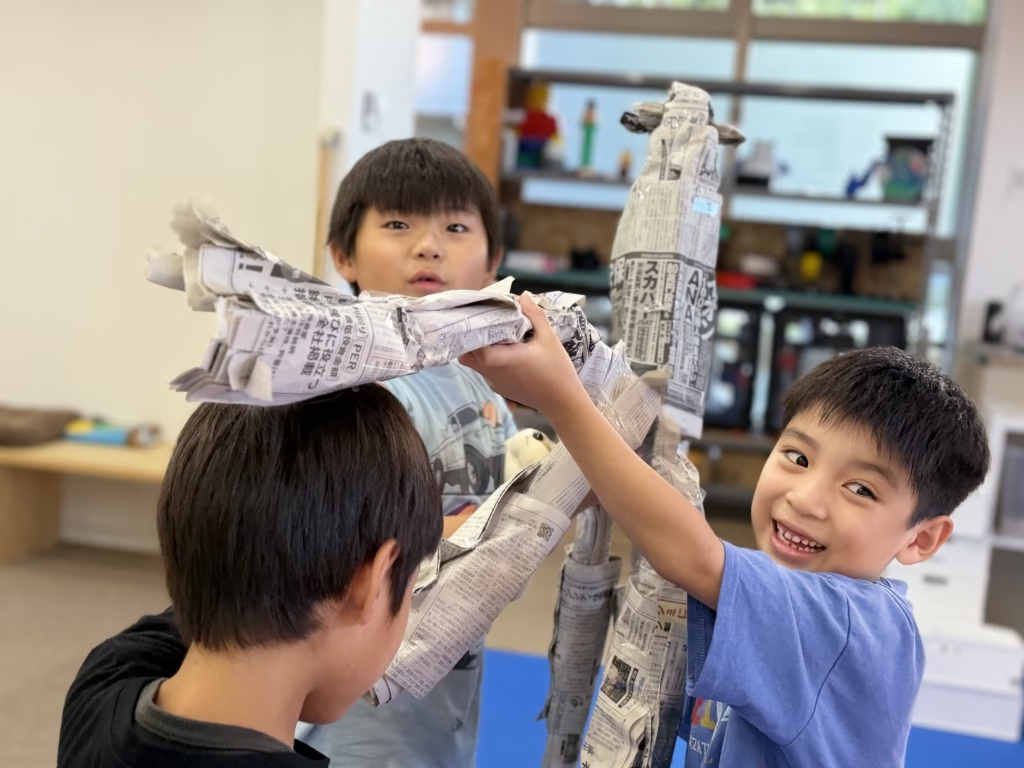
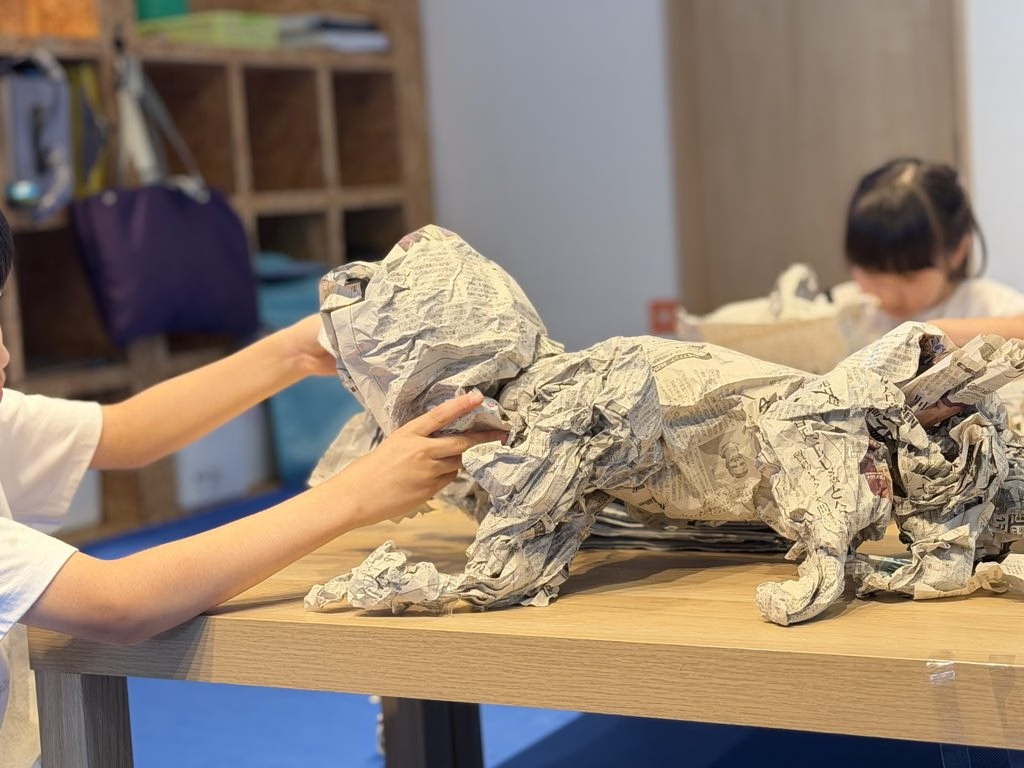
For example, an activity like "Let's make an animal out of newspaper" is simply a craft if children just copy a sample. But when a condition is added, such as "How can we make a giraffe that doesn't fall over using few materials?", it becomes inquiry-based learning.
Children think about structure, build small models, and test their strength. If it falls, they discuss the cause and try again by changing the shape or how they use the materials. The children decide roles among themselves and divide the work. The center of learning is not the finished product but the thinking and trial and error along the way. This division of labor is sometimes directed by the facilitator and sometimes done spontaneously by the children.
The potential of inquiry-based learning shown by research in the U.S.
In a study evaluated by the U.S. Department of Education's What Works Clearinghouse, project-based science learning was compared with regular lessons among 2,371 third graders in 46 schools in Michigan.
In the lessons, learning began with real-world questions such as "How do we design a fun, moving toy that any child can make?", and the children collected data, thought about evidence, and built models and products.
As a result, the children who took the project-based lessons showed statistically significant positive results not only in science achievement but also in indicators of reflection, agency in learning, and collaboration. This study was rated by the U.S. Department of Education's standards as a randomized controlled trial that "meets standards without reservations."
However, this does not mean that anything labeled inquiry-based learning produces the same effect. In this study, a clear question, connection to subject knowledge, sustained activity, work products, reflection, and sufficient teacher training were combined.
Inquiry-based learning does not mean leaving everything to the child; what matters is that adults do not give the answer first and instead provide scaffolding for thinking.
3 benefits of inquiry-based learning at an after-school club
1. You can test the "why?" from daily life on the same day
An after-school club has many seeds of familiar questions: craft materials, play with friends, discoveries in the neighborhood.
The strength of inquiry-based learning at an after-school club is that children can test questions on the spot, such as "How can we make it sturdier?", "What rules would let everyone play?", and "What could we make for someone who is in need?"
2. Mixed ages build the ability to explain
In a private after-school club, children of different grades spend time together. Older children explain to younger ones, and the younger children's simple questions can give rise to new perspectives.
Experiences such as conveying one's ideas in a way suited to the listener and accepting different opinions lead to the ability to collaborate.
3. You can try "one more time" after a failure
In school lesson time alone, there are cases where you can't get as far as redoing the work. An after-school club, on the other hand, is a place where life and learning are continuous.
On the day of a failure you can think "next time I want to do it like this," and try it the following week. Accumulating these small improvements builds the perseverance of "even if I fail, I can change my method."
What is Craftsman's Learning Friday?
Craftsman After School's Learning Friday is a 60-minute inquiry-based learning program held every Friday. As a "Friday of learning," children face questions with no single right answer, building their "ability to think" and "ability to see things through."
Activities include the following.
- Debates, mini meetings, and finding tasks
- Digital making using 3D printers
- Extracurricular activities and group work
- Programming with Scratch
- Presentations and exhibitions of what they make
What we value in Learning Friday is not using tools in itself.
With a 3D printer, for example, we do not let children operate it freely from the start; we have them think through "What do we want to solve?", "What shape is needed?", and "Was the printed part really useful?"
For the lower grades we prepare pictures, choices, and simple roles, and as grades go up they progress to measuring dimensions, modeling, and design. While matching each child's stage of development, we gradually widen the parts the child can decide for themselves.
Our staff are not people who give the right answers but facilitators who draw out children's thinking.
"Why did you think that?"
"Where do you think it went wrong?"
"Is there a way other than adding more materials?"
Through questions like these, we support the cycle of inquiry-based learning: "try it, get stuck, consult, fix it."
Summary: Becoming a child who moves forward on their own through inquiry-based learning at an after-school club
What children will face in the future are problems with more than one answer. What is needed is not only the ability to memorize knowledge, but the ability to ask questions, choose information, talk with others, and move forward while trying things.
Inquiry-based learning does not refer only to special research or difficult inventions. Its starting point is to value familiar "why?" questions, test your own ideas, and learn from the results.
At Craftsman in Kitayamata, Yokohama, through Learning Friday we value not only successful works but also the time spent unsure, the experience of failure, and the process of rethinking together with peers.
From a child who is "taught" to a child who "moves their own learning forward." We nurture that small step through after-school inquiry-based learning.
References
- MEXT, "Period for Integrated Study (Inquiry)" (in Japanese)
- MEXT, "GIGA School Initiative x Inquiry Learning" (in Japanese)
- U.S. Department of Education What Works Clearinghouse: Effects of project-based learning in elementary school science
- Krajcik et al. (2023) Assessing the Effect of Project-Based Learning on Science Learning in Elementary Schools
- Craftsman After School, "Inquiry-Based Learning (Learning Friday)"